Reviews

Saturday, 1 June 2013

Degree Show highlights - Central St Martins and Westminster

I haven't attended degree shows since I started art writing so thought I would change that this year. The first two were Central St Martin's and Westminster University - the two couldn't be more different. Read on for my top picks:


This is a vast show as you'd expect from an arts institute of this pedigree. The number of artists on display meant it had the feel of an art fair - with all the pros and cons that come with it.

It guarantees that I'd like at least some works but the art overload meant that pieces that require reflection, are abstract or slow building (especially applicable to video art) often failed to grab my attention in the few seconds I had for an initial glance.

First to grab my eye was Helen Saunders' 'still life videos'. The abandoned yet serene scenery she's captured has a melancholic beauty to it. Yes it is a video and subtle, the irony of my views in the previous paragraph are not lost on me.


Shinji Toya's booth challenges the nature of art. By asking a computer to randomly generate an abstract image, it questions whether abstract art created by humans should have any more intrinsic value. A similar theme to that raised by the Outside Art exhibition at the Wellcome Collection.


Tanya Tier's sense of humour also appealed to me - a giant hammer on a chain is linked to a panel that says break in case of emergency. The futility of the work brings to mind all the nonsensical signs we encounter in everyday life.

Mette Hammer Juhl has produced a playful series where everyday objects are transformed into fountains. It's fun but is also an attempt to bring something magical into an often mundane world.


Light has been a growing influence in the art world, and art students have also been experimenting with it. There were some particularly strong works featuring light here. 

Louise Beer's pulsating strobe lights in a dark room are an intense experience, only matched by Olafur Eliasson's fountains in the Hayward Gallery's Light Show. You can only bear it for a few minutes but the light appears to jump out of you and it leaves you feeling disoriented.


My favourite work of the exhibition was by YuLong Wang. It's a combination of laser light and what I assumed to be dry ice to create a primordial soup of shifting shapes in the vapour. By encouraging visitors to blow on it, creates rippling light effects that are captivating.

You will have noticed traditional painters are lacking in my highlights and I was disappointed by the lack of any cutting edge painters - particularly in representational works. The one painter that stood out was Marianne Morild for her use of bitumen to give her work a depth and weight that would normally require lots of layering of paints. The splashes of colour gave this work a Fiona Rae-esque feel to it.


This exhibition couldn't be more different to the above and I preferred its layout. It utilised the cavernous space of the Ambika P3 to display works that were neatly spaced out, giving them room to breathe.

This meant we had less works on offer and only two works stood out for me.

Kostas Synodis plays with our views on the solidity of walls by having a clamp appear to compress a wall and pipe pass straight through another. Here's an earlier work of a similar ilk:


As well being humorous it also makes the viewer feel at unease. Plaster walls are always seen as safe and reliable, we lean with our full body weight upon them and think nothing of it. This artwork makes us rethink whether we should be so trusting.

Nabeelah Moosun has mocked up a chamber akin to those used to handle radioactive materials. Gloves on each side allow visitors to handle the objects inside and you expect there to be something dangerous inside, but there's nothing within the sheets or beneath the cardboard. This anti-climax spoke to me of the nanny state and the culture of fear that we're surrounded by.

Friday, 31 May 2013

Manchester Art Gallery

As I was in Manchester for a training course during the day, I decided to explore its art gallery. Great to see they also do late openings on Thursdays much like in London so this gave me until 9pm to wander at my leisure. Note: This is my first comparison between London and Manchester galleries and it won’t be my last – London is my home after all!

Another similarly is that like the National Gallery they also had classical musicians playing during the late opening, which is always a nice ambience for exploring art – but the purist in me prefers the silence to absorb the detail in the works.

I was gutted that I arrived the week after the Raqib Shaw exhibition had ended – I loved his work a few years back at the White Cube so I’m sure I would’ve enjoyed a larger exhibition.  But luckily there were many works that were worth the trip - the quality of the collection will never match those of the major museums in London but I went on a chronological tour and have picked out some highlights. 

The first thing to hit you is the fantastic atrium and grand central staircase where every wall at the top of the stairs is covered with paintings to admire as you ascend.  Ignore the familiar names like Tissot and Sickerts – it’s not their best works and they pale in comparison to the superior neighbouring works by lesser known artists.


The staircase is flanked by a diptych of reliefs by Harry Bates titled War and Peace respectively that literally jump off the walls in a display of expert casting. Also of note is Edward Matthew Ward’s Byron as he stares longingly through a window at the object of his affections – the contrast of internal warmth versus the darkness that envelops our protagonist gives him the sinister air of a disturbed stalker.
However, the best work is a portrait of a pretty young girl by Albert Lynch – despite her youth stares confidently back at the viewer.


We then pass through rooms with familiar names like Reynolds, Gainsborough and Hogarth but these didn’t stand out for me. When we get to a Turner depicting boats amongst tumultuous waves it’s amazing to see how one of his works can own a room and drown out adjacent paintings. This is when I recognised that having all the Turners together at the Tate Britain does rob them of their potency to a degree.


The oddest addition to these classical paintings is a lone Banksy – it’s interesting to see how the few contemporary works in this collection have to be hung incongruous to the rest of the art. He’s a major artist that deserves to be displayed in a gallery so it must be a challenge deciding where to hang it.  The other notable contemporary work is a video by the divisive Spartacus Chetwynd, but it lacks the barmy energy of her Turner Prize nominated performance.

The Pre-Raphaelite collection is excellent. Even though I’d seen the Tate show only last year, I was still impressed by the powerful works. John William Waterhouse idealises feminine beauty in his painting of Nymphs while John Millais’ biblical scene of Moses being supported by his sons would not look out of place among early Renaissance works.  Arthur Hughes’ Ophelia contemplating plunging into a lake to drown herself is evocative – it may not be as effective as Millais’ Ophelia but is still a great work in its own right.


The impressionism and post-impressionism section can’t rival the collections at the National Gallery or the Courtauld, but breeze through these and head to the Dutch paintings section to see a fascinating juxtaposition of classical and contemporary art.  Interspersed among the vanitas paintings are Mat Colishaw’s ‘Death Row’ series – easily his best work that takes the last meals of death row inmates and photographs them in a Chiaroscuro style to capture the emotion that these plain foodstuffs belie.


On an adjacent wall is a ‘moving still life’ by Rob and Nick Carter. It’s a video work that appears to be a still vase of flowers until the breeze flutters the petals – wait long enough and a snail, ladybird and butterfly all make appearances. It’s an interesting take on still life and in my opinion better than the similar works by Julian Opie.

There is also some Lowry works scattered about which only sought to whet my appetite for the Lowry exhibition coming soon at the Tate

I’ve purposefully re-arranged my recounting of the gallery to preserve the best ‘til last. Gallery 9 states that it’s a temporary exhibition but please let it be permanent as this small room is worth the trip up to Manchester just to see it. There is an impressive array of Francis Bacon works, with a screaming homage to Pope Innocent a real treat.

For me the gallery’s best work by miles is a huge Kossoff painting of York Railway Bridge from Caledonian Road. I’ve recently seen a great exhibition of his work in London but this blows all of them away. The paint is so thick and effusive that you feel that if you touched it, the paint would leap off the canvas and encase your hand – it’s like the work is alive and breathing! No image could do it justice so I haven't included one.

Overall an enjoyable visit with some excellent works, and I recommend you pop in if you’re ever in Manchester. 

Saturday, 27 April 2013

The Other Art Fair 2013 - Highlights

The Other Art Fair is a bi-annual art fair held at the cavernous Ambika P3 opposite Baker Street station. It's an opportunity for artists not represented by galleries to showcase their works and for the savvy collector to pick up a bargain - no gallery representation means no commission and reasonable prices.

This format naturally lends itself to the cliched mixed bag of art, some would argue that they aren't represented by galleries for a reason. And last year's fair was disappointing. But this year's jury, including the critically acclaimed artist Yinka Shonibare, has resulted in some great artists being featured.

Here's a run down of my favourites:

Before I even got to the fair, there were Toni Gallagher's rats made of ice lining the walk from the stairs to the entrance. Here they are earlier in the year on the Hungerford walkway that connects Embankment to the South Bank


If it weren't for the fact they were still being laid out as I arrived, I may not have noticed them. 

Once inside the fair, the first stand to really grab my attention was the metal landscapes and cityscapes by Frederic Daty:


I was told that the artist starts with a single sheet of metal and then laser cuts way pieces and uses various substances to rust the sculpture and create the impressive range of colours. I found the more rusted works to be my favourites as they felt more rooted in realism - this forest was one of two that I really liked.

Hidden underneath the stairs were the clever lenticular prints by Shaun Caton and Derrick Santini. Their works change as you walk past them and play out scenes such as two identical women fighting each other or a woman speaking to you.


Clearly a still photograph doesn't do it justice but it was great to see a collection of their work after seeing one work of a swan fighting a woman at Cynthia Corbett's Young Masters exhibition.

Next up was Laurence Poole who take utilitarian objects to make art, such as a colourful canvas of matchbox cars or a soundwave made from vinyl records.


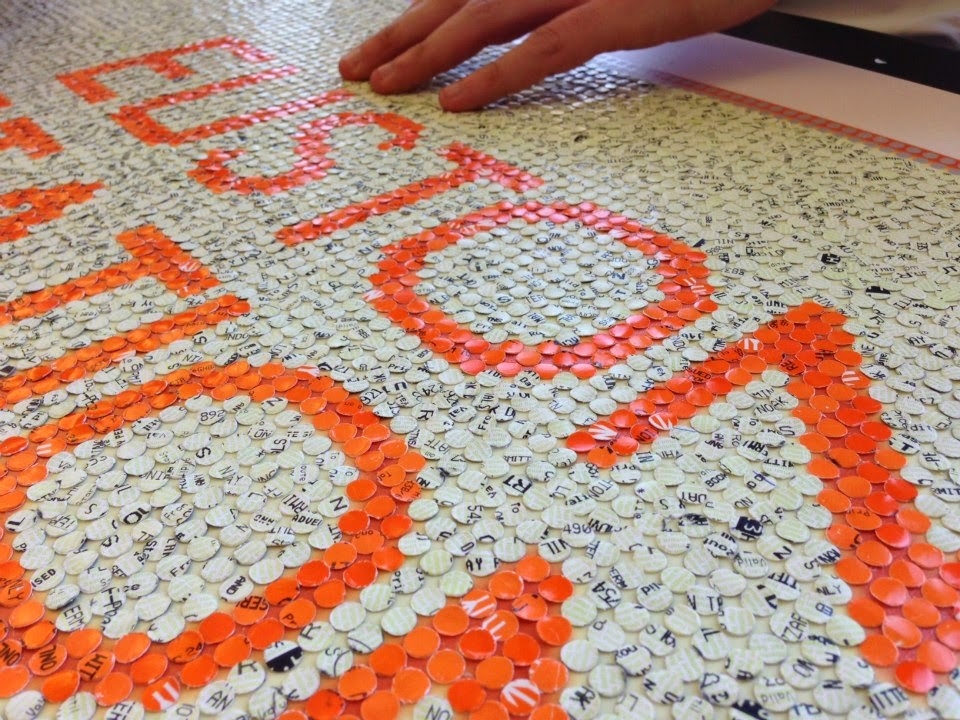
The Acrylicize Collective had a large scale replica of a monopoly board square marked as Euston Station. But it's only upon a closer look that I realised it's made up of hole punched National Rail tickets - very impressive, here's a close up.


Now my next artist has already featured on Londonist for her iPad drawings. I got to see some of Nadja Ryzhakova's newer work and was impressed by her rendition of the Lloyds building in a thunderstorm. It's not on her website but you can enjoy her underground full of fish-people instead. All of her works are all the more impressive for having been done on an iPad.


I enjoyed the photo collage's of Barbara Nati as she merges the present with a science fiction future. There's a cheeky sense of humour at work with an astronaut within a tram on an alien planet.


Last but not least was probably my pick of the fair. Conrad Engelhardt takes corks that have been naturally stained and uses them to create nudes and a portrait of Marilyn Monroe. 


It's a slow process but use of innovative media is doing very well, just look at Nick Gentry and his use of floppy disks or David Mach's wire hangar sculptures. For this reason, I was surprised that a gallery like Opera or Rook & Raven hasn't already snapped him up.

In summary, some great artists on display and well worth the visit.

Friday, 29 March 2013

Life and Death: Pompeii and Herculaneum

Verdict: Go see it
Where: British Museum
When: 28 March - 29 September 2013


Mosaic of a guard dog. From the House of Orpheus, Pompeii, 1st century AD. Copyright Soprintendenza Speciale per i Beni Archeologici di Napoli e Pompei / Trustees of the British Museum

Most people are aware of the devastation wrought by Mount Vesuvius on the town of Pompeii in AD79, though some may be less aware of the other towns that were also overwhelmed such as Herculaneum.

This exhibition opens with a plaster cast of a dead dog curled up in a position that captures the agony of its dying moments. The collar signifying it was a guard dog - how poetic that it would die carrying out its duty of guarding the home. The information does spoil this romantic notion slightly by correctly pointing out this curled up position is actually due to tendons contracting from the heat but that doesn't take away the power of this opening. 

Yet this first exhibit is misleading, for this exhibition doesn't really dwell on death and devastation but focuses on the lives of the ordinary folk in the towns of Pompeii and Herculaneum. Here's a chance to see how day to day Roman life played out, demonstrated by a set of remarkably preserved remains - right down to a roundel of bread where the bakers stamp still looks fresh, even if the bread itself has been carbonised.

This show is replete with well preserved artefacts from marble and bronze statues to furniture and even the sign of a local tavern. The way the two towns were destroyed by Vesuvius was slightly different so that Herculaneum has had all its wooden objects carbonised rather than destroyed. This includes a blackened baby's cot and we're told that the poor child's remains were found inside it. 

The main thrust of this exhibition is to show us the daily lives in an average town. Rome may have terrific records but it's a completely different way of living - akin to comparing London living with a sleepy Lancashire village. One major surprise is how much the towns were reliant on slaves emancipating themselves with the blessing of their masters and becoming citizens of their town - demonstrating that a slaves lot didn't have to be so bad nor permanent.

For me, the most revelatory aspect of this display is the similarities to society today. Sure the Romans were much less conservative around sex but there are lots of easy comparisons to make. The bars were known for drunken fights and the politicians commissioned posters of themselves giving out bread for free - the Roman equivalent of kissing babies.

We also see that many citizens had some amazing items in their possession. A mosaic of sea creatures and a table whose single leg has been carved into a panther are two stand out pieces but they are by no means the only exemplary items here.

This excellent exhibition ends with a look at the end, as you'd expect, showing us remains of a family killed together and items that have been recovered from people who tried to flee - some took their money, others treasured possessions. It's a harrowing reminder of all the lives snuffed out, but they also hint at there being much more to discover in the remaining debris. Despite the tragedy that befell these two towns, the insight provided from their well preserved remains is a unique look back at Roman life that we wouldn't have otherwise.

This exhibition does live up to the hype and is yet another success for the British Museum. The news suggests many tickets have already sold out and people are already queuing from 7am for on the day tickets, so make sure you plan your visit well as any history or art fan will want to see this show.

Saturday, 2 March 2013

Art 13 - Highlights

London is replete with art fairs from Frieze down to the Other Art Fair - so much so, that my list keeps growing. Art13 is the latest to try and muscle in on this prime market and it has aimed itself squarely at the likes of Frieze and the London Art Fair.

It's cast its net quite wide including bigger names, emerging galleries and a significant international contingent including many from Eastern Europe.

Though the layout is very confusing to navigate, the opening night had a real buzz to it and here's my run down of the artworks that most stood out for me:

Zilvinas Kempinas, Fountain. Courtesy Galerija Vartai

The concept is so simple, a fan plus magnetic tape creating rhythmic pulsations. Yet it's amazing how closely it resembles a water fountain in fluidity and sound.

I've recently come across a Mayfair gallery specialising in contemporary photography called Brancolini Grimaldi. They had a particularly strong showing and I liked two of their artists:

Miles Aldridge, Like a Painting. 

This photograph reminded me of the pre-raphaelites in it's beauty and intensity. The model appears doll-ish and this enhances its surreality.

Peter Fraser, Untitled

Fraser manages to capture the light perfectly, so as to imbue the mundane with the magical. Here a simple plate of fruit glows with life.  Brancolini Grimaldi are also having a solo show by Joachim Brohm which I will be reviewing in a month's time.

Mat Colishaw has been featured in many publications for his current, and frankly average, exhibition at Blain|Southern, but here we see him on form:

Mat Colishaw, Last Meal series

Colishaw has photographer the last meals of prisoners on death row but has used dramatic lighting for a chiaroscuro effect.This was my favourite as the mundane coke and fries sits so uneasily with the overly dramatised representation, a technique usually preserved for the finer foods.

Ben Turnbull, Heroes III. Courtesy Eleven Fine Arts

I enjoyed how the background was made up of comic speech bubbles and the title mixes the styles of spider-man and Captain America. Despite all the comic book pretences, it's actually referring to real heroes such as firemen and how Hollywood glosses over them in preference of fictional characters. 

Carlo Gavazenni Ricordi, Gates of Rome. Courtesy Fine Art Society
The subtle use of collage photography overlays produces an impressive technical result that had us wondering whether it's real pictures overlaid or some trippy hallucination.

This sculpture (below) may not be subtle but we've all felt like this at some point in life, especially when stick as a commuter on the Underground.


Atoosa Vahdani, Mortar

There was also some flashbacks of the ongoing exhibition by David Breur-Weil in the tunnels near Waterloo station.

The Outsiders, as their name suggests, was one of the galleries that stood out with a real Shoreditch vibe. Some other street art galleries, like Lazarides with their amazing mock brickwork stall, made sure they didn't look too out of place. The Outsiders feature prints by Zevs (pronounced Zeus), but this was my favourite:


Zevs, Liquidated Olympic Rings

All of his works highlight the bleed in of consumerist culture into our lives but I particularly liked this one for acknowledging how the Northern hemisphere, especially the US and Europe bleed into other cultures in developing countries, which have no way of preventing it.

The Outsiders also attempted to rebel against the fact people have to pay to enter an art fair just to think about buying art. So they gave away a free print to anyone who wanted it. A noble gesture though not quite as anti-establishment as they were marketing it to be.

Galerie Paris-Beijing had a wide variety of artists from the subtle to the high impact, summed up neatly by my two favourite works.

Yang Yongliang, Moonlight. Courtesy Galerie Paris-Beijing

This ethereal backlit cityscape amongst the hills feels both familiar and like an alien world at the same time.

Kim In-Sook, Saturday Night

It's probably too small for you to see but each window is a microcosm of relationships form a simple hugging couple to a full blown orgy. It's not subtle but a reminder of how everyone behaves behind closed doors and it's very voyeuristic, making you want to see what's happening in each window.


Kim Joon, Drunken-Gone With the Wind

I liked this work as even though it's a massacre of broken bodies and outright carnage, the porcelain flower patterning gives it a contrasting sense of serenity and stillness. 

Ricardo Rendon, Area de Corte. Courtesy Zipper Galleria

I make no excuses in saying that I'm drawn to works that catch my eye, mainly because a busy and bustling art fair is not a great place for subtle pieces. But this one's mystery drew me in - the middle has been removed and lies in pieces on the floor, but what did it show us? Was it a detailed masterpiece or just a sheet of grey? There is a sense of loss, exacerbated by the leftover frame sagging forlornly.

And these are just the artists I didn't know of! Other returning favourites included Mela Yerka's varied and subtle portraits and the impressive door carvings of Vhils.

Clearly lots to like and I'm sure it and I will be back next year.

Sunday, 20 January 2013

London Art Fair 2013 - Highlights

I managed to catch the very last hour of the London Art Fair, so had to rush around the 120 galleries as fast as possible trying to absorb all the art while noting down artist's names and the galleries that represent them.

I probably owe a few people apologies as I stuck to the cursory and rhetorical 'hi, how are you?' as I dashed past some familiar faces.

Anyhow, several works by artists I haven't come across before stood out to me, so I've listed them below, complete with images of the work:


Alberto Duman, View of the palace of Westminster and Big Ben. Courtesy England Gallery

If ever you needed proof that a picture paints a thousand words, this is it. Love the devilish sense of humour in using 'lots of people' and 'cloudy sky'.

Itamar Jabani, Man Holding a Child. Courtesy the artist

The version at the fair was similar but was protruding from the wall with a baby, as if offering it to passers by so that it may be saved.

Pamela Stretton, Skin Deep. Courtesy Mark Jason gallery

What's not visible is that this image is made up of tiny labels, all for skincare products such as Dove of Nivea. It's sensationalist yet the sepia tone gives it a more subtle feel. Still it does a great job of mocking the unsubtle marketing campaigns of the cosmetics industry.

Renaud Delorme, Angelina Jolie. Courtesy Absolute Art Gallery

This wasn't the exact picture there but loved the technique. Sure Nick Gentry's floppy disk canvases look better but Delorme adds the extra dimension of painting on plexiglass held over the mixed media background - this way the image looks different whichever angle you see it from.

Zac Freeman, Steve. Courtesy of the artist

Yet another inventive use of objects to create a portrait - this time it's toys. What I particularly enjoyed was that something playful has been used to create images where all the faces have a stern look upon them.

Russell West, Square Rainbow. Courtesy the artist

This brought a smile to my face, just the bright colours and chaotic style in which paint has been applied to an uneven frame is so expressionistic and bursting with creativity.

Carl Melegari, Merthr Miner. Courtesy Kooywood Gallery

It's great how the miner appears out of the gloom and the style reminds me of the work of Francesca Leone.

Jeremy Kidd, Thames 2. Courtesy of the artist

There were many photo-collages of cities on display but it's hard to go up against the superb work of Tom Leighton. However, the transition from day to night is a new angle and Kidd's sky above the HMS Belfast with Tower Bridge lit up in the background is glorious.

Tim Flach, Golden Tabby Tiger from Tiger breeding series. Courtesy Osborne Samuel

Firstly I didn't even know Golden Tabby Tigers existed but apparently they are a rare sub-species of the Bengal Tiger. On top of this the portrait is so unnatural, akin to a model shoot in a studio.

Emily Allchurch, Urban Chiaroscuro 4: Rome (after Pironesi)

This Escher-esque landscape also has a Da Vinci feel to it. It's a cauldron of so many different styles yet it works so well. Her larger works got more attention but this was the one that caught my eye as it felt like a real cityscape that's been contorted.
Matteo Negri, Lego's Mondrian Homage. Courtesy TAG Fine Arts

Another work with a great sense of humour about it and a knock at al of those who look at Mondrian's work and say 'anyone can do that'. I think it would've been more poignant if it was a replica of one of his famous compositions in red, yellow and blue, but still made me smile.

Helen Maurer, Eclipsed by the Boy. Courtesy of the artist

This viewpoint doesn't do this work justice but what's on the back wall is a reflection of the glass shelf that forms part of the work. It's an innovative piece, similar in technique to those of James Hopkins that are currently on display at Scream gallery.

Francesco De Molfetta, Snack Barbie. Courtesy of the artist

This one has been grabbing the headlines as soon as the London Art Fair opened. Yes it's another unsubtle reference to consumerist culture but the execution is brilliant. Barbie is often heralded as the reason for young girls having self-image issues so it's nice to see her getting her comeuppance so to speak.

Richard Estes, D-train. Courtesy Artnet and the artist

These hyper-real train views caught my eye. They seem to revel in both providing perfect detail yet also appearing dream-like.

The above are just the new artists I've noticed. There were plenty of old favourites on display including Andrew Salgado, Nancy Fouts, Suzanne Moxhay and Ye Hongxing.

Look forward to visiting London Art Fair again next year.

Saturday, 5 January 2013

Doctors, Dissection and Resurrection Men

Verdict: Go see it
When: 19 October - 14 April 2013

Wax anatomical model of female human head showing internal structure of skull, German(?), 19th century. Image courtesy Museum of London

There was never any doubt whether I'd be intrigued by this exhibition, after all I did spend much of my second and third year at university dissecting human cadavers. Even today, recounting stories of my dissection days merits askew looks and some revulsion from others at the thought of taking apart another human being.

This exhibition does an excellent job of highlighting how much more controversial it was back in the early 1800s. Religious superstition was prevalent and the commonly held belief was that your buried self ascended to heaven so dissecting dead bodies was on a par with mutilating a living person. Novels such as Mary Shelley's Frankenstein also had people concerned that doctors would be able to re-animate the dead. 

Yet at the same time medicine was advancing, and it needed to. This was a time when broken bones were treated with an amputation without anaesthetic followed by cauterising the wound - the pain must have been unimaginable. So doctors and medical students needed dead bodies to practice on but they were in short supply. Nobody would even consider donating their bodies and the only legitimate source of cadavers were from executed criminals.

To meet this growing demand an illicit trade in body snatching started up and these so-called 'resurrection men' would dig up bodies and deliver them to hospitals and private medical schools. The doctors would have known they were not legally sourced but they chose to turn a blind eye - perhaps convincing themselves that practising on these bodies would heal future patients and so this was all for the greater good.

All of this information and more can be found in this exhibition and it's remarkable the lengths that people would go to to prevent these grave robbers from taking their loved ones after they'd passed. There is an iron coffin from the period that was impregnable to attack by crowbar and a bear trap that would've been left in a graveyard for unsuspecting thieves.

But the depravity didn't stop there as some criminals went even further, resorting to murder and then passing the bodies over to doctors as having died of natural causes. The most infamous pair were Burke and Hare but there's also a video looking at three other criminals who murdered a boy and tried to pass him off as a disinterred corpse. But the fresh nature of the body led doctors to raise the alarm and they were arrested. The final irony being they were executed and therefore their bodies were used in dissections. The video itself is very much over the top with a cockney Ray Winstone-esque narrator who is more comedic than threatening.

It was only in 1832 that a law was passed that any unclaimed body could be used for dissections. It was a tough battle to get this law through as opponents argued it would unjustly single out the poor but proponents countering that the medical knowledge would help the poor who were in greater need of medical treatment. After the law came in it led to the closure of the private medical schools and also the end of the dark era of resurrection men. 

This exhibition is full of interesting facts about how dissection took place in the past even down to the fact that preserving bodies was nigh impossible at the time so dissections could only take place during the winter months. Yet despite primitive medicine being practised the wax and bone models used by medical students of the time are impeccably detailed (as seen above).

Even the decor fits in with the grisly past with paint splattered on the walls to look like dried blood and blood-red plastic curtains dividing sections of the exhibition.

We then move on to more recent discoveries. In 2006, excavations at the Royal London hospital produced the remains of several persons used for dissections, this is the event that triggered this exhibition. A room is dedicated to this finding but it's not as fascinating as the previous rooms.

The display ends brilliantly leaving visitors mulling over some philosophical questions. There's a video about whether people would donate their organs to save others and there's still a lot of stigma attached to this with people wanting to be buried 'whole' and one person believing an urban legend that doctors are less likely to resuscitate an organ donor. It even touches on whether the UK should have an opt-out rule so that everyone is an organ donor unless they explicitly opt-out.

The final thought I was left with was, as donated bodies for dissection are still hard to find, should I feel some guilt for having dissected two bodies (albeit shared with others) and not used that learning in my current career?

This exhibition is intriguing, entertaining and thought-provoking. An excellent insight into a grisly past and well worth the £9 admission fee.